


Common Motorcycle Crash Injuries and Clinical Outcomes
Motorcycle accidents often result in multi-system trauma due to the fundamental physics of two-wheeled travel. Unlike passenger vehicle occupants, who are shielded by crumple zones, steel safety cages, seatbelts, and supplemental inflatable restraints, riders absorb kinetic energy directly upon impact. When a motorcycle collides with another vehicle or fixed barrier, the operator is frequently ejected from the machine, leading to primary impacts with the opposing vehicle and secondary impacts with the pavement, guardrails, or roadway infrastructure. Lower extremity injuries remain the most frequent clinical presentation in emergency trauma centers, frequently involving compound or comminuted fractures of the tibia, fibula, patella, and femur, alongside extensive soft-tissue tearing and knee ligament disruptions.
Traumatic brain injuries (TBI) represent the leading cause of death and long-term functional impairment among motorcyclists. These injuries range from mild concussions and post-concussive syndromes to severe diffuse axonal injuries, epidural hematomas, subdural hematomas, and subarachnoid hemorrhages. Beyond cranial trauma, pelvic ring disruptions, clavicle fractures, brachial plexus nerve avulsions, thoracic crush injuries, and severe road rash (traumatic friction burns that strip the epidermis and dermis) often present complex clinical challenges requiring urgent debridement and skin grafting to prevent systemic infection.
Age Demographics and Injury Severity Patterns
Clinical data demonstrates that injury patterns and physiological vulnerability shift markedly across different rider age demographics. Older motorcyclists—specifically those aged 40 and older—exhibit higher rates of thoracic trauma, including multiple rib fractures, flail chest, pulmonary contusions, and pneumothoraces when compared to younger operators. Age-related decreases in bone mineral density and chest wall compliance mean that identical crash impact forces cause significantly more structural damage in older riders.
Furthermore, the physical characteristics of the motorcycle itself influence trauma severity. Operating heavyweight touring bikes or cruisers equipped with large engine displacements—typically 1,000 cubic centimeters or greater—is statistically correlated with elevated rates of severe head, chest, and pelvic injuries. The substantial mass of these machines can trap lower limbs during a slide or crush the rider under the bike’s frame during low-side or high-side crash dynamics, compounding the mechanical trauma delivered during a wreck.
Helmet Efficacy and Long-Term Prognosis
Helmet utilization serves as the single most effective intervention for mitigating fatal cranial trauma and reducing the severity of traumatic brain injuries. High-quality helmets engineered to meet Department of Transportation (DOT), Economic Commission for Europe (ECE 22.06), or Snell Memorial Foundation standards utilize expanded polystyrene (EPS) liners that crush under load, decelerating the head and dissipating rotational and linear kinetic energy before it reaches the skull.
While personal protective equipment cannot eliminate all risks in catastrophic collisions, wearing a certified full-face helmet drastically reduces the likelihood of open skull fractures, facial disfigurement, and fatal intracranial hemorrhages. For riders recovering from polytrauma, long-term functional recovery depends heavily on early specialized intervention, comprehensive neurological rehabilitation, reconstructive orthopedic surgery, and sustained physical and occupational therapy tailored to their specific injury profile.
Immediate Action Protocol Following a Crash
When a motorcycle collision occurs, standard roadside instincts must give way to a structured emergency protocol designed to preserve physical health and protect legal accountability. The physiological adrenaline surge following an impact often masks excruciating pain, internal hemorrhaging, soft-tissue tearing, or cerebral micro-bleeds. For this reason, calling 911 and obtaining comprehensive emergency medical triage at the scene is mandatory, regardless of whether you believe you walked away uninjured.
Once physical safety is addressed and responders arrive, gathering contemporaneous evidence becomes critical for establishing the mechanical reality of the crash.
Critical Evidence to Gather:
- Comprehensive Visual Documentation: Take clear, high-resolution photographs and videos of all involved vehicles from multiple angles, focusing on impact points, skid marks, gouge marks in the asphalt, fluid trails, debris fields, and obscured traffic signs or signal lights.
- Witness Information: Collect full names, phone numbers, email addresses, and physical addresses of any pedestrians, motorists, or nearby business employees who witnessed the sequence of events before, during, and after the crash.
- Law Enforcement Documentation: Request the responding police agency’s incident report number and record the badge numbers and names of the primary investigating officers.
- Physical Gear Preservation: Secure your helmet, riding jacket, boots, gloves, and any damaged onboard cameras or GPS units in their post-crash condition without washing, cleaning, or altering them.
- Personal Medical Log: Maintain an immediate written record detailing all emergency room diagnoses, follow-up physician assessments, imaging reports, physical limitations, and daily pain levels.
Critical Errors to Avoid After an Incident
In the chaotic aftermath of a motorcycle crash, casual remarks and hasty decisions can severely undermine a legitimate legal claim. Never apologize, express regret, or make speculative statements regarding speed, visibility, or braking distance at the scene. Statements like “I didn’t see them coming” or “I laid the bike down to avoid hitting them” are frequently distorted by defense adjusters into admissions of driver error or inattentive operation.
Additionally, you should decline to provide recorded statements to third-party insurance representatives until you have conferred with an attorney. Insurance adjusters are trained to ask leading questions designed to elicit ambiguous answers about pain levels, pre-existing conditions, or vehicle speeds. Finally, maintain total social media discipline throughout your recovery; insurance defense investigators routinely monitor public and private profiles for images, check-ins, or physical activities that can be taken out of context to argue that your injuries are exaggerated or resolved.
Navigating Motorcycle Accident Recovery and Legal Rights
Securing fair compensation following a severe collision requires establishing civil negligence under the law. To prevail against an at-fault motorist, an injured rider must establish four fundamental legal pillars: duty of care, breach of duty, direct causation, and quantifiable damages. Drivers owe a legal duty to maintain proper lookout, obey traffic control devices, yield the right-of-way, and share roadways safely with smaller, two-wheeled vehicles. Proving that a driver violated this duty—such as executing an unsafe left turn across oncoming traffic, tailgating, or driving while distracted—forms the cornerstone of any formal compensation claim.
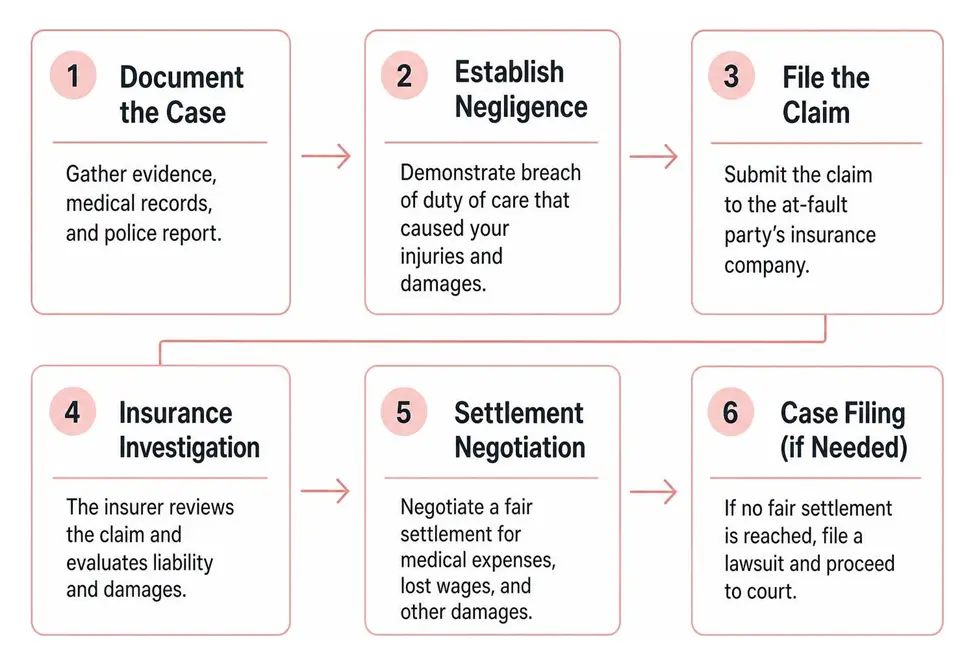
Understanding the comprehensive trajectory of a motorcycle accident recovery is essential for protecting both your long-term physical well-being and your financial stability following a major crash. Navigating this process demands a clear appreciation of how medical treatment milestones align with the valuation of your legal damages.
Medical Milestones in Motorcycle Accident Recovery
The medical phase of recovery is rarely linear. It begins with acute trauma stabilization, emergency orthopedic fixation, or neurosurgical intervention, followed by inpatient rehabilitation, specialized wound care for friction burns, and outpatient physical and occupational therapy. Over several months or years, physicians track patient progress toward “Maximum Medical Improvement” (MMI)—the clinical stage at which a patient’s condition has stabilized and no further significant functional recovery is anticipated, even with additional treatment.
Prematurely settling an injury claim prior to reaching MMI represents a severe financial mistake. Until treating physicians determine the permanence of nerve damage, joint mobility restrictions, chronic pain, or cognitive deficits, calculating the lifetime cost of future surgeries, home modifications, medication regimens, and assistive devices remains impossible. Comprehensive medical documentation during this period creates the factual foundation needed to defeat insurance carrier arguments that treatment was unnecessary or unrelated.
Financial and Legal Phases of Motorcycle Accident Recovery
Accurately evaluating a catastrophic motorcycle claim requires quantifying both immediate financial losses and long-term economic disruption. Sustained trauma often prevents an injured rider from returning to their previous trade, especially in physically demanding occupations requiring heavy lifting, prolonged standing, or fine motor dexterity.
Legal counsel frequently collaborates with forensic economists and vocational rehabilitation specialists to assess the diminution of earning capacity. These experts evaluate employment histories, educational backgrounds, projected promotion trajectories, inflationary wage trends, and fringe benefit valuations to calculate the present-day value of lifetime earnings lost due to the crash. Integrating these economic projections into demand packages ensures that settlements and trial verdicts account for decades of diminished earning power.
Compensation Framework: Economic vs. Non-Economic Damages
Civil tort law categorizes recoverable damages into two primary categories: economic damages, which reflect measurable out-of-pocket financial losses, and non-economic damages, which compensate for intangible human losses and physical suffering.
Damage Type Specific Recoverable Examples Economic Emergency trauma care, surgeries, physical therapy, prescription medications, future medical procedures, past lost wages, loss of future earning capacity, motorcycle repair or total loss replacement, adaptive medical equipment. Non-Economic Physical pain and suffering, emotional distress, post-traumatic stress disorder (PTSD), physical disfigurement and scarring, loss of bodily function, loss of enjoyment of life, loss of consortium for spouses. Comparative Negligence and Settlement Adjustments
Motorcycle claims are frequently challenged by deeply ingrained “biker bias”—the unfair cultural stereotype that all motorcyclists are inherently reckless, speeding, or risk-seeking. Insurance defense attorneys exploit this prejudice to shift fault onto the injured rider under Pennsylvania’s modified comparative negligence framework.
Under Pennsylvania law (42 Pa.C.S. § 7102), an injured plaintiff can recover damages provided their share of fault does not exceed 50%. However, any financial recovery is diminished in direct proportion to their percentage of attributed negligence. For example, if a jury determines that a total claim is worth $500,000 but assigns 20% comparative negligence to the rider for minor lane positioning or speed discrepancies, the net recovery is reduced by $100,000 to $400,000. If the rider is assigned 51% or more of the blame, they are legally barred from recovering any compensation. Solidifying liability through accident reconstruction analysis, traffic camera footage, and black box telemetry data is critical for eliminating unfounded claims of rider fault.
Pennsylvania Statute of Limitations and Filing Deadlines
In Pennsylvania, the statutory deadline to initiate a personal injury lawsuit arising from a motor vehicle crash is strictly governed by a two-year statute of limitations (42 Pa.C.S. § 5524). This statutory countdown begins on the exact date of the collision. Failing to file a complaint in the appropriate court before this deadline permanently extinguishes the claimant’s right to pursue compensation, regardless of the severity of their injuries.
Certain cases involve shorter administrative notice deadlines. If a crash was caused or exacerbated by a hazardous municipal roadway condition, missing highway signage, defective traffic signals, or a negligent government employee operating a public vehicle, Pennsylvania law requires formal written notice of intent to claim to be filed with the relevant municipal or state agency within six months of the incident. Prompt legal evaluation prevents catastrophic procedural defaults.
Frequently Asked Questions About Motorcycle Accident Claims
How does helmet use affect personal injury compensation under Pennsylvania law? Pennsylvania law allows adult riders aged 21 and older who have held a motorcycle license for at least two years (or who have completed a state-approved motorcycle safety course) to ride without a helmet. If an unhelmeted rider is injured, defense attorneys may argue that failing to wear protective headgear constituted a failure to mitigate damages regarding specific cranial injuries. However, the absence of a helmet does not prevent a rider from establishing that another driver caused the crash, nor does it bar recovery for non-head injuries such as orthopedic fractures, spinal trauma, or internal organ damage.
What makes motorcycle insurance coverage distinct from standard auto insurance in Pennsylvania? In Pennsylvania, standard automobile policies are governed by choice no-fault insurance rules involving “limited tort” or “full tort” elections. However, motorcycles are statutorily classified differently: motorcycle insurance policies are not bound by limited tort thresholds, meaning injured motorcyclists can pursue non-economic damages (pain and suffering) without having to prove a “serious injury” threshold. Conversely, motorcycles do not automatically provide First-Party Medical Benefits (PIP) unless specifically purchased as an optional add-on, making private health insurance and Uninsured/Underinsured Motorist (UM/UIM) coverage vital.
Why is Uninsured and Underinsured Motorist (UM/UIM) coverage critical for riders? Pennsylvania requires drivers to carry a minimum of only $15,000 in bodily injury liability coverage per person. In a major motorcycle crash, emergency room stabilization and surgical care easily exceed this nominal minimum within hours. Carrying substantial UM/UIM limits on your motorcycle policy protects you by stepping into the shoes of an at-fault driver who carries no insurance or insufficient liability limits to cover your total economic and non-economic damages.
How do economists calculate future lost earning capacity in severe injury cases? Forensic economists utilize customized actuarial models combining your pre-injury earnings, age, work-life expectancy, professional skill level, and educational history with physician-established disability ratings. They account for cost-of-living adjustments, inflation rates, and lost retirement contributions, discounting the resulting lifetime sum to present market value to provide a defensible financial valuation for trial.
Conclusion
The aftermath of a serious motorcycle crash presents profound physical, emotional, and financial challenges for riders and their families. Recovering from multi-system trauma requires focused medical care, disciplined evidence preservation, and a strategic understanding of personal injury law. By securing immediate clinical evaluations, documenting every facet of the crash scene, and asserting your statutory rights within strict filing deadlines, you can effectively overcome institutional insurer bias and secure the comprehensive financial compensation necessary for lasting stability.
Also READ
- making-sense-of-your-first-online-accounting-class/
- features-whole-home-air-conditioning/
- /best-air-purifiers-home-symphony/

